5.10.25 How to grow orchid seeds with B1 fungus
Part 1: The things you need
This series of blog posts is a detailed description of how to grow orchid seeds with B1 fungus, expanding on the website content. If you have any questions please feel free to Email me (see below).
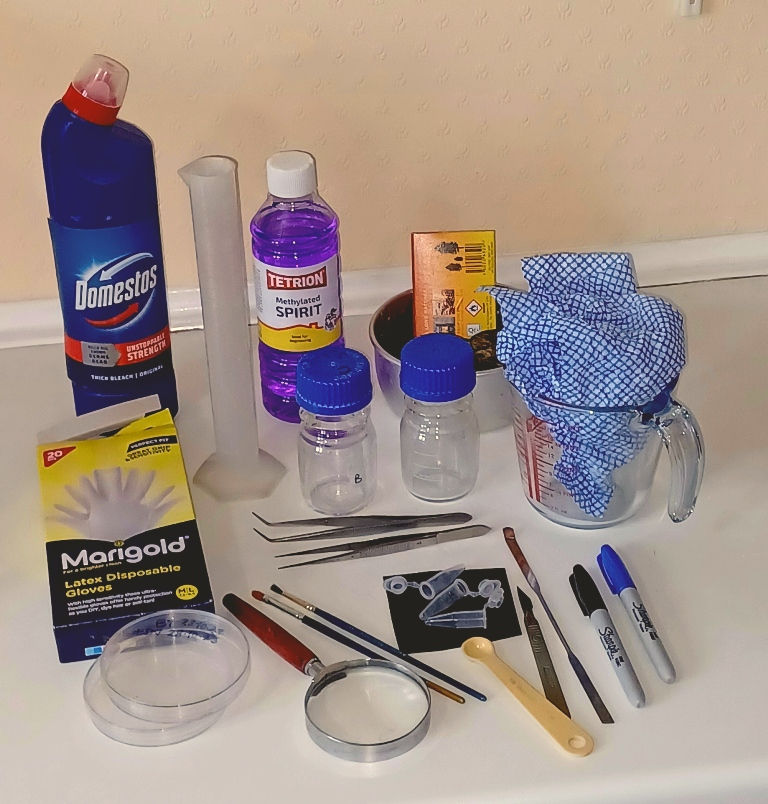
Traditionally fungus is grown on agar gel nutrient medium in a Petri dish. Orchid seeds are added. The fungus facilitates germination and growth into small protocorms. I describe a reliable method I have used for years, but there are many other viable approaches or variations. Most things are cheap, bought on the internet or at any supermarket. Remember you can always improvise if you don’t have a particular item – just be creative!
Orchid seed: Most Dactylorhiza and Anacamptis species work with B1, plus others such as Spiranthes spiralis, Herminium monorchis etc. but many other species do not. It is best to start with Dactylorhiza fuchsii. This is readily available and grows well. Obtain seed only from ethical sources such as your own plants, or the Hardy Orchid Society (H.O.S.) etc. Store dry in paper envelopes at room temperature or in a fridge for the long term.
B1 Fungus: This is a strain of Ceratobasidium (see Heys A.D., Journal of the H.O.S., Vol 9 No3 (65) July 2012, pp 93-97). It can be obtained from the H.O.S. It comes as an agar culture in a Petri dish and is best stored at room temperature in the dark, eg a drawer. It needs to be re-cultured from time to time.

Sterile cabinet: It is best to try to keep all work sterile i.e. free of contaminating microbes, although B1 grows strongly and tends to overcome contaminants. One may get away with “highly clean”. I work in a homemade cabinet with see-through Perspex walls and hand holes. It protects the work overhead from airborne microbes falling in. Other improvised cabinets, boxes or covers can work well.
Scientific glove boxes or laminar flow cabinets are purpose-made for sterility but very expensive and not necessary. The inside of the cabinet, and all things in it, are wiped with a J-cloth moistened in Domestos bleach that has been diluted 1 volume plus 9 volumes of water, ie 10%.
Petri dishes are ideal incubation containers, but other transparent vessels could be used. New Petris are sterile but used ones can be re-used indefinitely by 10% bleach-wiping.
The growth medium is Basic Oats Medium, which is 3.5g/L powdered oats, 5.0 to 10.0g/l agar powder, and approx. 0.1g/L marmite (for B vitamins) all mixed in tap water. I am in a hard water area and this works fine. You could use de-ionised water, as sold for car batteries, but it is not really necessary. Use porridge oats powdered in a kitchen blender then finely sieved or alternatively oat flour directly. Agar should be of fairly pure general laboratory grade and can be found on the internet but may need a little hunting around. Gelatin is a possible alternative. A digital kitchen weighing balance accurate to about 0.1g is useful for weighing out materials but not essential. Alternatively you can buy ready-made Basic Oats Medium sachets from the H.O.S. – simply add water!

Pressure cooker: this heats the medium to approaching 120 deg C which is enough to kill off virtually all microbes and their spores. Boiling at 100 deg. C does not completely sterilise but might work.
Glass jars with loosely fitted lids contain the medium inside the pressure cooker. This could be honey or jam jars, but best are 100mL Duran bottles. Petri dishes cannot be used as they deform or melt.
General household items that are very useful include: paper towel roll, plastic food bags, permanent marker pen, pyrex glass jug, kitchen rubber gloves, disposable latex gloves, artist’s soft watercolour brush, and a magnifying glass.
More specialised laboratory-type things or their improvised alternatives: a few plastic Pasteur pipettes (pastettes), small 1.5mL plastic Eppendorf centrifuge tubes for seed pre-treatment, small plastic measuring cylinders, a metal spatula, scalpel, and fine forceps.
For sterilising forceps etc I use a small camping spirit burner with methylated spirits, but there are other ways of doing this, such as alcohol hand gel or 10% bleach-wiping.
Next time Part 2: Pour the medium, add fungus and seeds!


Comments